|
|
Farafra:
Known as Ta-iht or the Land
of the Cow in Pharaonic times, is a single village. The most
isolated of the New Valley Oases it is renowned for its strong
traditions and piety. According to folklore the villagers once
lost track of time and had to send a rider to Dakhla so they could
hold the Friday prayers on the right day. The oldest part of the
village, on a hillside, is next to peaceful walled palm groves; a
short fide away there are hot sulfur springs at Bir Setta and
swimming at El-Mufid Lake. As in other oases many of Farafra's
houses are painted blue (to ward off the Evil Eye) but here some
are also decorated with landscapes, birds and animals, the
handiwork of local artist, Badr. A combination house, museum and
studio exhibiting his paintings and ceramics are situated in a
garden full of sculptures made from objects found in the
surrounding desert. Another local, known as Mr. Socks, sells
beautiful hand-knitted camelhair sweaters, socks and scarves. Day
trips by jeep and camel treks from, here to the White Desert,
Bahariya, Dakhla and Siwa can be arranged through Saad's
Restaurant.
Qasr
Al-Farafra:
The only real village in the Farafra Oasis, Qasr Al Farafra is a
quite and relaxing place, which represents most of what it has to
offer tourists. There are few tourist accommodations in the area,
but that may change in the near future. Most of the description of
the Farafra Oasis applies to the town itself.
Kharga:
used to be the last but
one stop on The Forty Days Road, the infamous slave-trade route
between North Africa and the tropical south. Today, it is the
biggest New Valley oasis and its modern city houses 60,000 people,
including 1,000 Nubians who moved here after the creation of Lake
Nasser.
Camping facilities are available near both villages. Further south
is Baris Oasis, the second largest settlement in Kharga. Houses
designed in traditional Nubian style by Hassan Fathy remain
uninhabited- local people refused to live in them because of their
similarity to tombs and building stopped in the late 1960s. Its
name derives from Kush, the ancient Sudanese capital, which traded
with Egypt along the Nile. Arcgeologists are still unearthing the
ancient city of Kysis with which the temple is associated; and
elaborate system of clay pipes and abandoned Christian church,
suggest that Kysis was abandoned when its underground springs
dried up but the exact date remains a mystery.
The
City of El Kharga:
El Kharga, as a product of the New
Valley Project, is a modern and growing city with an ancient past.
The Egyptian government has plans to make the area very attractive
to tourism.
The main square in town is Midan Nasser,where there is a statue of
a woman holding her children. She represents Egypt, and her
children are the oases.
There are a number of monuments in the area, as well as a museum.
It was from El Kharga, the ancient trading route that the Persian
King Cambyses' army of nearly 50,000 left Kharga in 525 B.C. and
perished in a sandstorm.
Dakhla:
The Dakhla Oasis lies to
the northwest of Kharga and is also about 310km to the southeast
of Farafra. This oasis has a population of about 70,000 people, is
the farthest oasis out of Cairo and is considered one of Egypt's
most beautiful oases.
Dakhla sits in a depression surrounded by pink cliffs. There are
about 30,000 acres of cultivated land. Most of its 70,000 or so
residents are farmers who constantly fight the battle of the dunes
that threaten their fields and orchards. The fields and gardens
are filled mostly with mulberry trees, date palms, figs and other
citrus fruits. Dakhla has retained most of its culture and charm
even though it has increased in size by about double and
government funding and technical training has revitalized the
economy. Dakhla is the only place in Egypt where new water wheels,
which are driven by buffaloes, are constructed. They are made of
palm timber and clay jars and are called "saqiyas". The
oasis is connected to Kharga by a 120-mile (200 km) road that has
buses running daily.
Researches found out that the Oasis has
beeninhabited since prehistoric times, and that there was once a
huge lake here. There are Neolithic rock paintings that indicate
that the lake was frequented by elephants, buffaloes and
ostriches. As the lake dried up, the inhabitants migrated to the
Nile Valley and were probably some of its first settlers.
Dakhla Oasis is dominated on its northern horizon by a wall of
rose-colored rock. Fertile cultivated areas growing rice, peanuts
and fruit are dotted between sand dunes along the roads from
Farafra and Kharga in this area of outstanding natural
beauty.Dakhla Oasis is a collection of 14 different settlements,
dominated on its northern horizon by a wall of rose-colored rock.
Fertile cultivated areas growing figs, peanuts and fruit are
dotted between sand dunes along the roads from Farafra and Kharga
in this area of outstanding natural beauty.
Al-Qasr
Village:
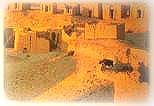
Al-Qasr at the foot of the limestone cliffs and on the edge of the
lush oasis is little changed from medieval times. With a
population of around 700, the town was built from its Roman ruins
and has narrow covered streets.
The sites of interest include a pottery factory and an old corn
mill. Mud bricks are still made in an ancient manner and there is
a foundry where men still work mettle using bellows flamed fires.
Back
|